Showing posts with label Bear Mills. Show all posts

Tuesday, May 5, 2015

A First-Timers Report on Traveling in China, Part I

No, the Forbidden City isn't forbidden any longer
We’ve had the privilege of traveling a lot, but nowhere was harder for us to wrap our brains around than China. My wife Caryl and I were invited to spend two weeks in The Middle Kingdom (China’s own self-description). All we had to do was pack, and be where we were told when we were told. And smile. And promote my two recent books. And begin work on one more.

In advance of the trip, we studied the history and geography of places we would visit. The “why” seems obvious; can you imagine traveling to Texas, seeing the Alamo, but not understanding its place in Lone Star history? A completely wasted experience.

But China’s history dates back to the Xia Dynasty, around 2700 B.C. That’s about the time that Abraham and Sarah were begatting Isaac. In addition to that, if you go to China and ask about the Zia Dynasty, people will look at you funny.

X is pronounced sh, not zzz. So it’s the Shea (sort of) Dynasty. Likewise, the city of Xi’an, where you can see the terracotta warriors, is pronounced more like Cheyenne (as in Wyoming) than anything else I can think of (Shee-ahn).

After months of investigation, followed by two weeks of travel covering over four thousand miles, here’s what we learned that may make China a lot more accessible to you:

If you want to read up on China before you go, start with the history of The Great Wall, the Forbidden City, Genghis Khan, The Three Kingdoms, and Mao. That will give you a good beginner-level handle on China.
Other basics:

Chinese money is known by three terms: RMB, yuan (u-ahn), and quai (kwy). The last term is the least formal. Stick to RMB or yuan.

Change your money at the airport. It is fast, easy, and of minimal expense. Changing it at banks in China involves a mountain of paperwork and took us at least two hours each time, if you can get them to change it. The further you get from Beijing and Hong Kong, the more trouble you’re likely to have.


The exchange rate is extremely favorable right now for Americans, around sixteen to one.

American credit cards are not accepted in many smaller cities (those under five million people). They’re not trying to be obstinate or anti-American. It’s just that the bank card processing software often isn’t in place.

China has one hundred and forty-five cities with more than a million people. The largest is Guangzhou (say Gwan-joe and people will know what you mean) with a metropolitan statistical area of roughly forty-four million people. Just because you haven’t previously heard of a city in China doesn’t mean it isn’t of major importance. There’s a lot more to China than Beijing, Hong Kong, Macau, and Shanghai.

China is both a world power and a developing country. It is not usual to see beautiful skyscrapers and hovels in the same neighborhood.

A traditional neighborhood in
the foreground and the new apartments
to which the residents will soon be "relocated"
in the background
Hotels in China must be certified to accept foreign tourists. Therefore, you can’t just stay anywhere. We typically paid about $50USD per night for a decent hotel. Most Holiday Inn hotels in China cost less than $68USD per night, according to Expedia.com. Luxury hotels shouldn’t cost more than $150 a night USD. Just make sure they have western/Muslim toilets.

Most cities in China are gigantic and the traffic is unbelievable. Stay in hotels close to the attractions you want to see and walk everywhere possible.

Sleeping on a Chinese bed is different, like sleeping on box springs in the US. Seriously.

"Non-free" accessories
A “Business Hotel” in China doesn't necessarily mean Courtyard by Marriott. It usually means it also features an hourly rate so people can go there to do their “business,” if you get my drift. That doesn't mean it isn't a reputable hotel; it’s just multi-functional. And there may be “non-free” prophylactics waiting for you on the bedside table, along with some "non-free" toiletries to help you freshen up before your "date." In a country where multiple generations live in the same small houses, sometimes people rent their privacy by the hour. These are called “micro-stays.” Also, people traveling long distances can use these hotels to take naps before their journey. Pretty nifty.


Most things in China are identified by where they are in relation to the “ring roads.” Ring roads are equivalent to our loops. If something is inside the first ring road, it’s near the center of town. Something outside the sixth ring road (if the city has that many) is out in the boondocks. Plan accordingly.

If you are trying to find the name of a tourist attraction, the best way we’ve found is to start your search on Google (if you’re not yet in China) or Yahoo (if you are). Sometimes places can have multiple names. For example, you can simply Google “Beijing Night Market” and learn that the real name of the place is Dong Hua Men Night Market. Now you can ask your hotel to write it down in Chinese, along with the address, for the taxi driver. Some places have multiple names, and the name can vary from guide book to guide book. Using Google to start your search allows you to figure out which multiple names refer
The welcoming committee at Zhangjiajie
to the same location. We found that in Hunan Province (a province is like a state in the US), the names Zhangjiajie, Zhangjiajie National Forest Park, Wulingyuan, Wulingyuan Scenic Area, and Baofong Lake all refer to roughly the same area. One guidebook listed it as Zhangjiajie, another as Wulingyuan. Without Google to sort it all out, we wouldn’t have had a clue.

China is one of the most polluted countries on earth. However, because of their political system, the factories can be turned off anytime the government says so. Hence, if the prime minister of Pakistan or trade officials from Australia are coming to town, suddenly the sky is crystal clear. If you can find a time when important people are heading to the city you want to visit, go then.

If you get lost in an airport, start asking for someone who speaks English. Often, the person who shows up will offers to walk you to where you need to be, including getting you through security in record time. Just don’t be surprised if he expects a couple of hundred RMB for his trouble (about $32 USD). Compare that to missing your flight and it seems like a pretty good deal.

Our guide at Zhangjiajie
Speaking of guides, you can book a guide in advance, but you’ll pay prime price. Most tourist venues have English speaking guides wandering about listening and looking for lost Americans (of course, so are the pickpockets and scam artists). You can hire these impromptu guides for much less than you pay online. Use your own judgement.

People in China eat at round tables with Lazy Susans in the middle. The food is placed on the glass Lazy Susan and rotated. You don’t load up your plate. You take a bit with your chop sticks, hold your small bowl under the food to keep from dropping it, and take it to your mouth. Everyone at the table is doing the same. Hence, double-dipping with your chopsticks is the norm. When you go, take antibiotics. Strong antibiotics. And Imodium.

Canadian pharmacies sell an excellent OTC anti-nausea medication called Gravol. We tried it after some bad food in China and found it worked like a charm. In the US, the same active ingredient at the same strength is sold as Dramamine. We just take one Dramamine, instead of two, for the Gravol effect.


Spitting, slurping, and nose picking are not social faux pas in China. Get used to it.

A formal setting with Lazy Susan
When you check into your hotel, you will see business cards for the establishment resting on the counter. Take several. They usually list the name of the hotel, the address, and directions regarding how to get back. Simply give one to your taxi driver when returning from sightseeing.

Have your hotel write down the name of the places you want to sightsee in Chinese, along with the address, so you can give the information to the taxi driver. Have them write it in English so you can keep it all straight.

People in China aren’t big on standing in lines. Go with the flow; don’t get mad, and don’t wait for people to let you in front of them. You have to gently, but persistently, nudge your way onto subways, into queues for places you want to visit, etc. When in Rome…
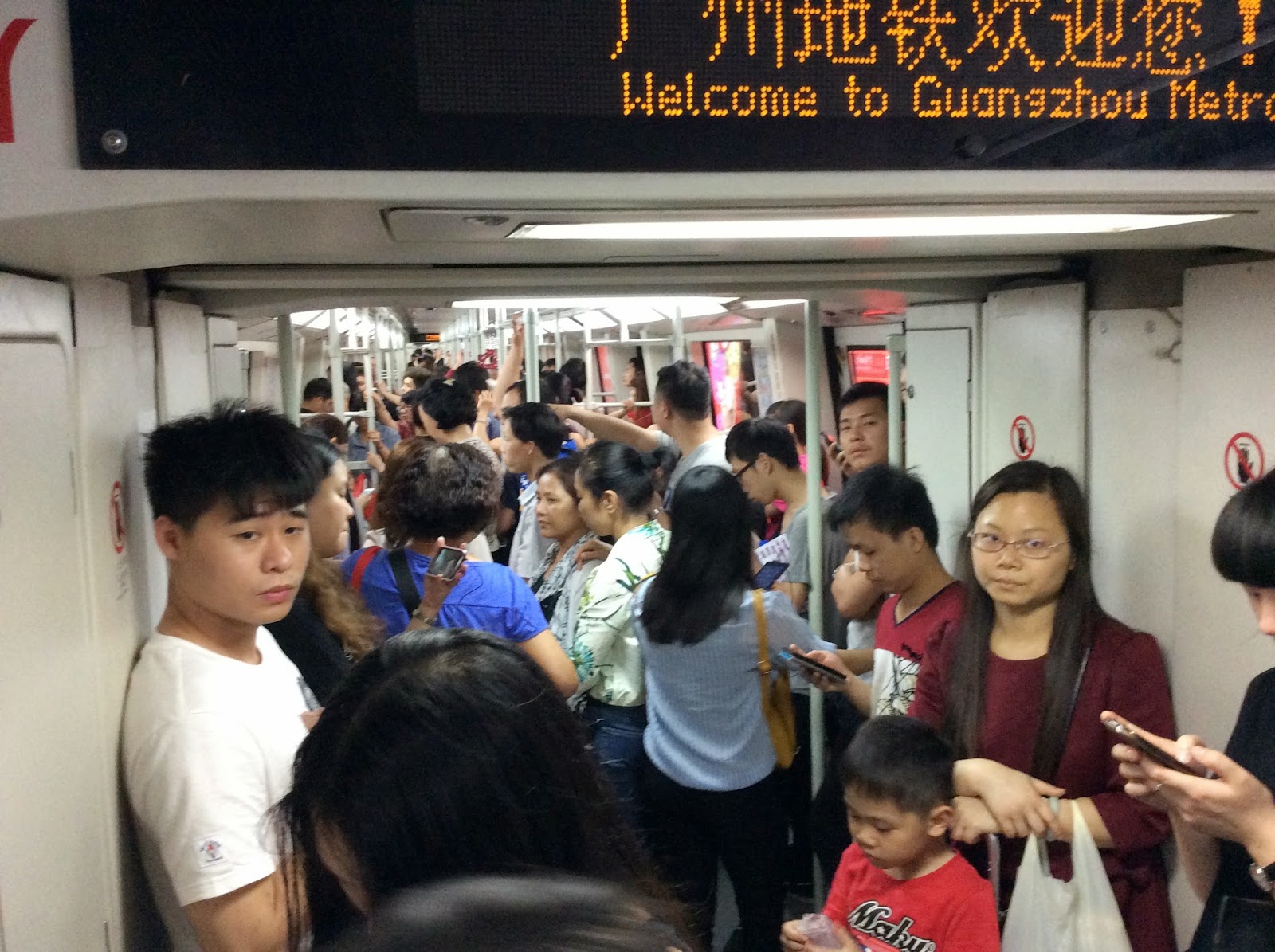
Subways are busy, even when
it's not rush hour
You are a guest in their country. Always assume that people around you understand English. Talk nice.

Chinese LOVE getting their pictures taken with westerners. They assume if you can afford to come to China, you must be rich-rich-rich. Who doesn’t want their picture taken with a super wealthy person?  You might be famous, too. Who knows? China is very good for the self-esteem of western tourists.


If you travel by train (which I highly recommend), make sure you book a “soft” sleeper. That means you are staying four to a compartment and your bed will be the most comfortable you sleep on while visiting the country. Take your own food, as selections on the train are expensive and limited. If you accidentally book a “hard” sleeper, you are in for an experience: Six people to a compartment, beds like rocks, and people who can’t read no-smoking signs in any language. By the way, if there are only two of you in a soft sleeper, that means you are sharing the compartment with two strangers. The only way around that is to book all four beds. However, if you only have two passports, that might be a nifty trick. Let me know how it works.

I was always a sucker for the upper berth

A First-Timers Report on Traveling in China, Part II

In a word, steep.
The Great Wall of China is steep terrain. Wear your most comfortable shoes. Badaling is a great access point located just north of Beijing. There’s a gondola/cable car that saves hours of climbing, though you will walk plenty once you’re at the top. Like most places in China, it is not very handicapped accessible.

Having said that, a blind woman from Great Britain said Beijing in the most blind-person-friendly city in the world.

Hotel rooms all feature electric kettles/hot pots that heat water to boiling. Essential for purifying your tap water and making tea, coffee, Raman noodles, etc. Hotels everywhere should have these.

China is known for tea, but they almost never have it in the breakfast areas of hotels. BYOTB (bring your own tea bags).

Same with coffee. A good cup of black coffee is almost impossible to find. We even visited a Starbucks that didn’t have coffee. Whaaat? They make it a pot at a time and were all out for that day. The closest thing you can find in convenience stores is Nescafe packets that also include sugar and creamer. Folgers makes coffee bags that travel well.

Take hand sanitizer and pre-packaged baby wipes. You can use the baby wipes as napkins, to clean surfaces  and chop sticks, and wipe your hands after climbing the Great Wall and other places where millions of other hands have been.

Bottled Cokes, beer, and wine won’t make you sick (depending on how many you drink). Avoid drinks with ice or from dispensers. Bottled water from stores is safe, but if you order a bottle of water from a restaurant, you don’t know but that it was filled there or poured – as a courtesy – into a dirty glass.

My wife reports Chico’s is a great place to buy women’s no-wrinkle travel clothes for your trip.

How NOT to pack
for China
Pack light and carry clothes with lots of polyester or Dacron so you’re not one big wrinkle. Rooms usually don’t have irons. Traveling light is imperative. Getting around with multiple bags is a nightmare. Plus, taxis have very little trunk space for your luggage. If you pack heavy, you will pay for it every day you are there. I even brought socks and underwear that I could discard along the way, so the bags got lighter and there was room for souvenirs.

Speaking of bags, suitcases over forty-four lbs get extra charges that can add up to $100USD on Chinese airlines. Did I mention, “Pack light?”

Make sure that if your passport is expiring within a year, you get it renewed before you apply for a Chinese visa. A ten-year visa is no more expensive than a one-year, but you can’t get one if your passport is expiring.
Certain areas of China have their own visa regulations. If you apply for a visa to Tibet, you probably won’t be approved; it’s a politically- and religiously-sensitive area. Hong Kong and Macau also have their own visa requirements. One size does not fit all when it comes to visas in China.

Beige air in Beijing
Carry sinus pills. The pollution is not your friend.


Ditto for peanut butter crackers and granola bars.

Your new best friend, food-wise, will be the simple, lovely, fried eggs they serve during breakfast at many of the hotel buffets.

I don’t care what the talking heads on TV say about all the exotic foods in China; starfish tastes like crackers and fish oil, and bugs taste like bugs. You’re probably not going to want to eat spicy duck head or chicken feet. And most chicken is cut up with the bones and cartilage included so you get “the good marrow.” Go to China for the history and the beauty, not the cuisine.

Speaking of beauty, take time to explore the parks and natural areas of China. Zhangjiajie National Park is one of the most incredible places on earth (or on Pandora, as seen in the movie Avatar). The city parks in Guangzhou (near Hong Kong) rival any urban green space you could visit.

Plenty of green spaces in Guangzhou
If you are a Christian and want to attend church in China, many large hotels offer an “international service” on Sundays. There are also registered Christian (Three-Self) churches in most cities. Visiting house churches is more problematic, as a westerner’s visit could bring down persecution on them from the State Administration for Religious Affairs (SARA).

Persecution in China rarely involves throwing someone in jail; too expensive and too much bad press. The most common forms of persecution involve a SARA official visiting a religious person’s work place or landlord and asking if that person is a troublemaker. That will usually be a “word to the wise” for the landlord or boss that it’s time to find a new tenant or employee.

As a visitor, you’d never want to intentionally or unintentionally cost someone their job or their residence. Be careful what you say at all times about religion, the Christians you may have met, etc. (James 1:19, Proverbs 17:28) Taxi cabs are not safe zones. Neither are translators. Just because they speak English doesn't mean they share your values.

China Southern Airlines features some of the nicest planes on which we have ever flown. Air China, not so much.

To understand the Chinese government, don’t compare it with that in the United States, Canada, or Germany. Compare it with Exxon Mobil, Microsoft, or any other large corporation. The citizens are employees. They are there to do a job. You, as a visitor, are on a factory tour. If a Chinese person grouses, but does his job, he is ignored. If someone is impeding productivity, that’s a problem. If Christianity, or any other religion, is thought to be impeding productivity, it gets shut down. If it improves productivity, it is, to a degree, encouraged. (Colossians 3:22-25)

Don’t count on Google, Facebook, or Gmail. They aren't available in China. If you want to communicate with the folks back home, find out the international texting rates (often not as expensive as you’d think. With Verizon, I paid about fifty cents a text, as long as it didn't include pictures). Also, set up a Yahoo or Hotmail e-mail account before you go.

If you like diet drinks, Coke Light is about your only choice, and it’s not widely available.

One of the most insightful things we did before going was to download the podcast Letter From China by Peter James Froning. He was an American teacher at a Beijing university for one year, sending back weekly e-mails on his experiences. Endearing and entertaining…and free, though you are encouraged to make a voluntary contribution if you listen to it.

Inner Mongolia is not the same as Mongolia. Inner Mongolia is part of China. Mongolia is more closely aligned to Russia, but regards itself as an independent country.

In spite of what you’ve heard, China is not free from religion. Buddhism, Hinduism, Christianity, Judaism, and Daosm/Taoism are all to be found. One of the most problematic religious groups for the Chinese government is Catholics, because of their loyalty to the pope as the ultimate earthly authority.

Welcome to China
And finally, let’s talk about toilets. Western-style toilets, often called Muslim toilets, can be impossible to come by in public. Even universities and nice businesses feature squat pots, not western toilets. If you don’t have good knees, this is an issue, pure and simple. Spend some time locating western toilets. And BYOTP. Seriously. At all times. Forget and you will be sorry. Yes, sometimes there is one giant roll outside the restroom, but sometimes not. I call it the Roulette Wheel. You guess how much you need, spin the wheel, and hope to get lucky. If you’re wrong, you crap out. (Hotels for foreigners have western toilets, but it never hurts to ask, just to be sure.)


Questions? E-mail me at wwbearmills@gmail.com. Happy travels!

Tuesday, March 17, 2015

How do you spell suspense? B.R.A.N.D.I.L.Y.N. An interview with Brandilyn Collins

Brandilyn Collins is my favorite living author. Her sense of suspense is second to none. I was first introduced to her through the Kanner Lake Series. If you enjoy suspense, it doesn’t get any better.

However, there is another side to Brandilyn Collins that we need to address right off the bat.  Though she wasn't writing to my demographic, her two romance series, The Dearing Family and The Bradleyville novels are also extremely popular.

Brandilyn, I know books don’t always get published in the order in which they are written. Which came first, the romances or the suspense novels? How did you decide to move from one genre to the other? Actually, I don’t write romance. Those books are considered simply “contemporary” or “women’s fiction.” They have large romantic subplots, but the main plot centers on family relationships.

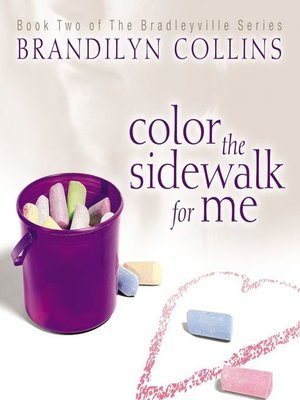
Having said that, my first novel was Eyes of Elisha, a suspense. My second (written) was Color the Sidewalk for Me, a contemporary. I had a huge learning curve to write Eyes Of Elisha, since it involves a lot of police work, forensics, and courtroom scenes. I’m not a lawyer, forensics person, or police officer, so I had to learn everything from the beginning. Plus, EOE came in the middle of writing a true crime, my first book to be published. (A Question of Innocence, my only book that’s now out of print.) The true crime took a lot out of me because it involved the death of a four-year-old. After writing that, and all the forensics research for EOE, I just couldn’t do another suspense. Since I was unpublished at the time I could write whatever I wanted. So I wrote Sidewalk. Later I wrote a prequel to Sidewalk, titled Cast A Road Before Me. Road was my first novel to be published, followed by EOE, then Sidewalk. The third contemporary novel in what came to be called the Bradleyville Series is Capture the Wind for Me. By the way, Cast A Road Before Me is free in ebook.
"You da man" "No, you da man."
Barndilyn Collins with fellow author
Ted Dekker on the 2010 Thriller tour.

What was the process that took you from being a person who wrote books to being a published author? The process? Lots of staying up all night, kicking cabinets, writing, writing, writing, and studying the craft. Oh yes, and ten years.
  
Discuss the first time you realized, “Hey, I’m a celebrity! People want my autograph.” Conversely, what are the downsides to celebrity? Wait, I’m a celebrity? Why didn’t anyone tell me this?

 Talk about the birthing process for your suspense novels. Lots of staring out windows. Lots of going down a maze run and retracing my steps. “Nope—that’s not the right path.” Far more “what if” premises run through my head than ever are actually written. My Seatbelt Suspense® brand promise has four points: fast-paced, character-driven suspense with myriad twists and an interwoven thread of faith. I've found it a very difficult brand promise to live up to. Some suspense plots simply couldn't start fast enough for my readers, who expect that fast pace to begin on page one. Some don’t bring about enough twists. So I pace and pray, and then sit down to write when I at least have the beginning and ending and the major twists figured out. The middle comes as I write. That’s the theory, anyway.

Honestly, writing is really hard for me. And with each book it seems to get harder. I have more “reputation” and reader expectations to live up to. I have to be fresh. And always, always, I want to represent the human condition in a true-to-life way, through well rounded characters caught in a compelling situation. Writing deep emotion takes a lot of energy. It can’t be skim-the-surface writing. I want my readers not just to read my scenes, but to feel them.

You live in Idaho and the Kanner Lake series is based in a small Idaho town. What was the reaction of your real-life neighbors when you brought fictional mayhem to a town not unlike the one you and they really live in? We had our second home in Idaho at that time, but we still lived in our main home in California. Now we live full time in our Idaho home. But even when we were in Idaho at the time that the Kanner Lake books were being released, people in the area loved that they were locally set. It’s fun to read a novel that takes place in a setting that is familiar to you. The reader can picture the streets and shops.

I’d love to do more Kanner Lake books, but the setting was, as you say, in a small town. And just how much mayhem big enough to receive national attention can you put one little town through? I do miss the characters, though. Methinks Wilbur is still sitting on his chair in Java Joint, crabbing about something and everything.

 There can be raised eyebrows when Christian authors create bad guys who are just a little too convincing. What kind of comments have there been from friends, church members, or family about some of the psychopaths who dot your literary landscape? What do you say when people ask, “How long has that person been living inside you?” What is your process for developing convincing baddies for your books? My mother always wondered where she went wrong. She also read all my books and loved them.

First, bad guys never think of themselves as bad guys. They have to do their bad thing, whatever it is, because of their own justification. Second, no character is all bad or all good. So I try to create a character with some good qualities, but who wants something VERY BADLY, and the only way to get that something is to do something VERY BAD. But it’s all okay, you see, because that person, in his mind, deserves to have whatever he wants.

Brandilyn meeting fans
Discuss how the publishing industry has changed in the years since you started writing. How has it altered the way you market and sell your books? After twenty-five books sold to publishers, I have now chosen to go completely indie (independent author), keeping the rights to my books and publishing them myself. This way I don’t sell my intellectual property, and I have full control over the release and content. For someone who’s as independent as I, this is way cool. (By the way, I have just gotten back the rights to my first two suspense novels—the Chelsea Adams Series: Eyes of Elisha and Dread Champion. I’m in the middle of doing a fresh edit for these books, so they’re currently not available online except for used paper copies. They’ll be up again soon.)

I know authors love all their “children,” but are there certain books you've written that have become your pets over the years? That’s always a hard question to answer. But I’d say Color the Sidewalk for Me remains probably my favorite book that I’ve written. Which is rather annoying, since it was only my second novel. (What is it—all downhill from there?) I got back the rights to the Bradleyville Series recently. All three novels have now been re-released. Before republishing them, I did a fresh edit. Reading Sidewalk fourteen years after it was first published, I am still greatly moved by that book. And reader letters about the story are terrific. (I have two fat files of letters and emails for Sidewalk alone.) Well, reader letters about all my books tend to be really positive. But when you get a letter from a man in his fifties who admits to reading a women’s fiction novel and bawling at the end—that’s a letter to remember. Of course he also added that if I ever attached his name to that statement he’d deny it.

That’s surprising you should say your favorite is Sidewalk, since it’s not a Seatbelt Suspense®, for which you’re best known. Yeah, I know. I’ve written a lot of high tension suspense novels, all of which I do really like. Now that they’re published, that is. When I’m in the midst of writing a book I always think it’s horrible and will be the one that will ruin my career forever. Over The Edge stands out to me, because the story line focuses on Lyme disease and the difficult issues of diagnosis and treatment. It’s another very suspenseful story. At the same time it contains a lot of information about Lyme. I've received incredible letters from readers about that book—how it’s helped save their lives.

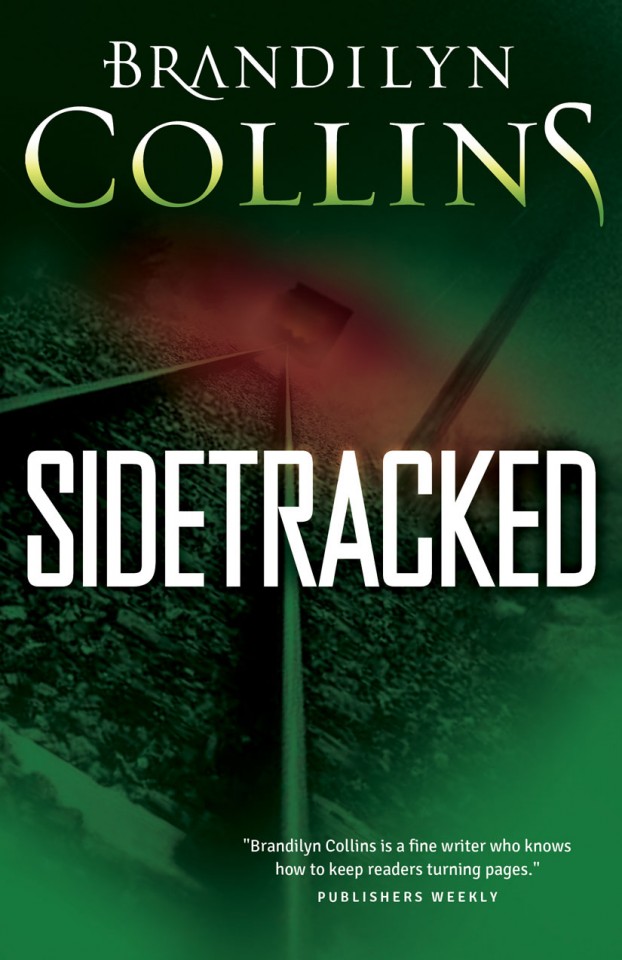
Sidetracked is my latest suspense and has proven very popular (over two hundred 5-star reviews on Amazon). Gone to Ground stands out to me because of the Southern characters and the eyebrow-raising premise. Dark Justice is about terrorism against the electrical grid—something that’s, unfortunately, all too feasible in today’s world. A lot of my books are finalists/winners in various awards, but that book holds the record at six. And you mentioned Kanner Lake. I do love the characters in that series also. The Hidden Faces series, featuring a forensic artist, are four of the scariest books I’ve written. I could go on, but then I’d be mentioning all my suspense novels.

Your book about the writing process stresses character development as being of supreme importance. Do you develop your characters first and then place them in a story or do you develop the plot line and then create characters to fit the necessities of the action? It HAS to be the former. That’s why the second point of my four-point brand promise says “character-driven.” Suspense is considered to be a plot-driven genre. But if you plot out a story and stick characters into it, they’ll be wooden. Character motivation drives choices. Those choices in turn drive further conflict. That’s why, when I begin to write a Seatbelt Suspense®, I know the beginning and ending, but not quite how I’ll get there. The characters grow as I write. They tell me how we’ll get there together. And if my planned ending doesn’t work for that character, I’ll learn that, too.

You mention on your website that in heaven, you shall spend all your time going from concert to concert. As a fellow music aficionado, share with me some of your favorite performers on this earthly realm. Rock bands. I’m a rocker from the 70s. Always have been, always will be. Well, since the 70s, anyway. Kansas. Boston. Journey. Foreigner. Styx. Little River Band, etc. Also I love gospel music. So yes, I shall run from gospel concert to rock concert. But the rock songs will have lyrics about God. Best combination ever.
Authors Frank Peretti and Randy Alcorn hamming it up at
Brandilyn's lakeside home in Idaho.

Speaking of musicians, Frank Peretti’s career moved into a whole different zip code when Amy Grant began talking about This Present Darkness a few years ago. Fantasize for a moment: Which performer would you like to see climb on the Brandilyn Collins bandwagon and which book would it be? Frank happens to live in my neck of the woods. It’s interesting to hear him tell that story. I don’t think I’d want a performer. I’d want someone in the news industry that’s highly watched. You wanna tip one or two of them off about me-that would be great.

Note: Read the first chapters of all Brandilyn’s books at her website. You can follow her on Facebook and Twitter.

Sunday, March 8, 2015

Author John C. Dalglish shares more than a name with P.D. James's famous detective

It's funny what draws us to a particular author or book. I was drawn to mystery/suspense author John C. Dalglish because his surname reminded me of P.D. James's great detective, Adam Dalgliesh. Yes, they're spelled differently. Like I said, these connections are funny.

What I found in Dalglish is a kindred spirit; a man who believes riveting suspense and killer action isn't defined by the amount of sex, gore, or profanity laced within its pages. Rather, it's the intricacy of the plot, attraction to the characters, and the amount of adrenaline pulsing through your veins as you turn the pages. 

Book ten of the Det. Strong series is now in print, proving he's found a winning formula that keeps bringing readers back for more. He also has a new "Chaser" series. Both are available through a variety of outlets, including Amazon and Kindle.
John C. Dalglish and friend

Tell us about Det. Jason Strong. The name is very evocative. What do readers need to know about this character?
The name for the character Jason came about as most of my names do; made up on the spot. What I think is interesting is that Jason was just a character to fill a roll, and was never meant to be a series. I tell people that I met Jason at the same time they did, when he walked onto the page. It wasn't until I was near the end of the book that I mentioned to some co-workers how much I liked the character. I decided to make a series out of him if the first book was well received.

We've heard other authors say they spent their entire lives writing their first book, but only got a few months to write all the ones after that. How has writing gotten easier or harder over the years?
I was discussing this with my wife this morning. I feel very fortunate that the stories come out of my head and onto the page in a fashion that I'm happy with. I rarely scrap large sections of a book. Obviously, there is much editing and tweaking, but the basics come out fairly organized. As far as easier-versus-harder, I can only speak for myself; it becomes harder to put out a good book, simply because you learn more about what a well-written book is, and how to do it. To write properly is hard, but more satisfying as you hopefully see yourself improve.

Take us behind the scenes regarding your writing process. Do you create an outline, start with characters and let the book write itself, or...?
I am very much an outline guy. I will begin with my basic premise, and write a series of scenes as bullet points. Things like- 'Jason goes to victims house', Vanessa goes to crime lab'- then start at the top. New ideas and scenes are added or subtracted by the story as it develops, but I continue to write in order. The most fun in the writing experience for me is watching what happens as I write the scenes. Details, conversations, action; they all come as I write and it's very exciting for me. (Hopefully, for the reader, too.)

You were born in Canada, but became an American citizen in 1991. How do you think your cross-cultural experiences have affected your writing?
I'm not sure the cultural differences have made much difference. Having said that, the fact that I have traveled in both countries, has given me a wider array of description possibilities.  My own feeling is that the life experiences, which give a writer something to draw on when he looks at emotions and reactions, are more important.

When people look you up on Amazon, they will see that you identify your books as "clean suspense." Tell me what you mean by that and why that's important to you.
Well, let's see; that's kind of a long story, but let me shorten it some. The first published draft of "Where's My Son?" had two or three swear words, and a little more descriptive violence than I would have preferred. I felt I needed them for realism. However, when I wrote "Bloodstain", I found I just preferred to leave it out. Following the publishing of the first two books, I received many letters thanking me for not using excessive language and sex. I discussed it with my wife, and made the decision to write 'clean' books. We reasoned that some of the top selling movies and books in the world were done by Disney, and there had to be a group of people that felt like we did. As a result, I went back and edited the first book and have been writing in that fashion ever since.

 How do you think the decision to not include gratuitous violence or sex has either helped or hurt your sales?
Without question, it has been a good decision. I have a police officer friend who I spoke to about this. I asked him if every third word from a cop was a cuss word. He laughed. "Hardly, that they were normal folks with normal feelings". He didn't say they don't swear, just that it doesn't occur at the level portrayed in movies. I still, ten books in, get letters thanking me for books that are 'clean'. They are the type I would read and I'm glad others do, too.

 You share surnames with one of my favorite characters of all time, Inspector Dalgliesh from the P.D. James novels. Ms. James has had a huge influence on my writing, as have Brandilyn Collins, Frank Peretti, and Sue Henry. Who are some of the writers who have most influenced your work?
Peretti is a good one, I enjoy his books a lot. Tom Clancy, and of all people, Erma Bombeck.  She taught me how to be funny in a book.

I asked you about Det. Jason Strong earlier, but you have another series that could probably be best described as "science (and faith) fiction." What is the Chaser Series?
I had a desire to do a pure Christian series, and the concept came to me as a takeoff on Touched By An Angel. What events could I create in a life after death scenario? I pitched the idea to my son, who is a fantasy author, and he liked it.

One of your books that has grabbed my attention and never let go deals with brothers Donnie and Billy Jarvis. Tell us about those characters and how you came up with the book "For My Brother" in which they appear.
You know, I'm not sure where the exact idea came from. My wife and I love the real life crime shows, and a lot of my basic ideas come from what bubbles up while watching them. The relationships in that book stem from events in my own life, and how events impact people's futures.

 Finally, do you consider yourself a Christian author or an author of books who is a Christian, if you catch the distinction. What do you think the secular market is like for those who refuse to play to the "Fifty Shades of Gray" and "Girl With the Dragon Tattoo" crowd?

First, as I think most believer's would say, I am a Christian. Everything I write, say, and do is shaped by that fact. So, I guess the latter statement would be true. As far as the "Fifty Shades" thing, I believe that Hollywood, Amazon, and anyone else in publishing, is willing to profit from a selling entity. I think the "Left Behind" series is a perfect example of that. Perhaps I'm naive, but I believe people want a good book, a story they get lost in, one that they feel sorry when it's over. I'm not sure the amount of sex or language determines that.

John C Dalglish's website is http://jcdalglish.webs.com/. You can find his author page at http://www.amazon.com/John-C.-Dalglish/e/B007LS4SV6